Wednesday, July 23, 2025
As of 2025, please go to stuff.davidaugust.com, my newer blog. See you there!
Please join me at stuff.davidaugust.com now.
I am now post to stuff.davidaugust.com and this blog is being decommissioned. Please change your bookmarks, links and feedreader settings. See you there!
Labels: technology, trends
this posted by David August at 11:58 AM - 0 comments - 

Saturday, May 20, 2023
As of 2025, please go to stuff.davidaugust.com, my newer blog. See you there!
Being Human in the Age of AI
being human is big, bigger than we usually think it is

There is a lot of talk about artificial intelligence (AI) doing as well or better than humans at things. Machines have long out-performed people at a lot of stuff. And this doesn't just apply to complicated machines like cars, but simple machines, like a lever, have long amplified or done better than us. A pry bar is better at prying things than our bare hands. But humans have not, ever since the first person used a rock to make their efforts easier, been made obsolete by the machines we've made.
Sure, some things we have machines do that people used to do. But humans haven't stopped existing because of this. If anything, machines have allowed us to grow: machines and technology are part of why there are more humans currently alive than there have been at any other point in history. Humans haven't been made obsolete by tech.
So why is AI disrupting things typically done only by humans? Things like writing, art making, film-making and acting are starting to be threatened by systems, artificial intelligence (AI) systems. Why isn't it pry bars and not artists? Life and limb.
A self-driving car getting things wrong immediately collapses into the tyranny of atoms: concrete and often irreversible consequences come when a machine driving itself ends a life, or ruins someone's property. While self-driving vehicles may get to the point they are safer than human drivers, they will never be perfect, and this imperfection when matters of life and limb are involved, makes them hard to cheer for or even experiment with out in the real world.
Not so with media, entertainment and the arts. Artistic creations made by non-humans don't leave grotesque consequences if they fail: any bad movies, books, music and more made by artificial-intelligence (AI) will fade into the noise floor of un-celebrated human artistic attempts. No life or limb is imperiled if an artificial intelligence (AI) made film falls flat, instead bank accounts and careers get impacted (and disappointed audience).
This lack of life and limb involvement can make creative and artistic endeavors feel like the "consequence-free" world of software and web development: as if one can fail quickly and iterate in order to experiment in public and refine as one goes. However, the context of software and any context where life and limb are in play react very differently to things if one tries to fail fast. Experimenting and learning are invaluable, but at scale and in public, the tyranny of atoms makes doing so with self-driving vehicles, autonomous weapons and other life and limb scenarios far more dire than an unpleasing painting or a film that flops at the box office.
While many life and limb contexts benefit from the fact automated and artificial intelligence (AI) systems don't suffer from fatigue, emotional compromise or inebriation, some of the same things that drive humans to be tired, emotional, or otherwise not consistent are vital to make good decisions in other ways. Logical decisions with zero emotion can be low quality decisions (there are studies suggesting this is true, but they are beyond the scope of our discussion here).
Artificial intelligence (AI) promises the benefits of intelligence with none of the "downsides" like inconsistency or asking for a paycheck. Taking humans out of the loop may be possible, even beneficial in some contexts. But imagining an artificial system will benefit from all the strengths we take for granted in humans (or even see as liabilities) seems a mistake. Human are imperfect according to humans. What we find desirable and what the universe has evolved us into for our survival as a species are not the same. Eugenics makes many errors, this is one among them. Humans are great at a lot, even things we don't think of as great.
Being human includes the foibles and messy parts. It's not pre-Copernican to suggest that humans, after millions of years of evolution, are excellent at being human. This includes messing stuff up, hurting ourselves and also creating great things, beauty, connection, grace, mercy, cruelty: all of it. To imagine in the space of a few years or decades one can do what has taken billions of people filtering through millions of years of evolving is the magical thinking here. To fall so I love with human ingenuity and creation as to believe in a few generations time we can out create the forces of evolution over the timeline of geologic epochs, that is feeling to me like the fallacy in this.
Yes, AI can do, and maybe even excel at, specific human-like tasks. The question of what is necessary and sufficient for something artistic to be art, what is the essential that makes art in fact art is an entire branch of philosophy. There is little consensus on this, and what makes art human, or what human component is necessary for something to connect and resonate may not have consensus either. That said: I think saying there is an X factor, some amorphous and undefined thing, that is a cop out.
The generative AIs, both images and text, are sophisticated mirrors. Highly complex yes, but basically reflecting back their prompt and their training data is all they're actually doing. Often compelling enough for us to forget this, but that is what is happening even if the results feel like more.
So here goes:
It is the vast and minute combination of human intuition, rationality, emotion, fear, power, weakness, apprehension, insight and ignorance. At the risk of paraphrasing the dignity of man speech in Hamlet, we might sum it up as the human condition.
Wikipedia, a source of common meanings, sums the human condition up as "the characteristics and key events of human life, including birth, learning, emotion, aspiration, morality, conflict, and death." Mortality and love (not just romantic love) certainly seem to figure in to what I think the condition of being human includes. And how love and mortality figure into making art, or any creation in a way, is somehow uniquely human. We can probably spend a long time and many words defining, describing and discussing this.
For our purposes: knowing we will die perhaps underscores all our actions with a fleeting immediacy, even if that immediacy is an undercurrent and not the focus of what we do moment to moment, day to day. Does a machine have a functional life? Of course. But none of its activities are filtered, really in any way, through a lens of that mechanized mortality. Even in the back of our minds, under our awareness, the fact we may stop existing does inform in both subtle and bold ways how we do what we do.
Fictional characters are often revealed by how the do what they do. In many ways, how we do what we do is who we are. How the character says what they say, matters almost as much as what they've said. I leave the studies on non-verbal communication dominating the information exchanged between people for others to detail elsewhere.
How someone lifts a coffee cup can speak volumes about them, what they have done, are doing and will do. Does the way they lift it reveal the old injury from their time in a past captivity? Do they lift it in preparation to enjoy a moment's respite from current stress? Are they preparing to go without coffee as they are due too enter a coffee-less meeting? All of these options and a myriad more impact how the simple act of lifting a cup of coffee happens. They can be revealed and communicated in many ways like how quickly, slowly, angrily, happily and a bunch of other details that we all notice, even if not consciously.
And this rich, deep, full bodied (pun intended) action and all it communicates (literally, emotionally and maybe even spiritually) happens on some level even from this mundane act of picking up a cup of coffee. It can be filtered (pun intended again) through the whole of the human experience of the person lifting the cup, and also through the whole of the our human experiences as we witness it. With varying levels of awareness and attention, our neurology encounters and interprets what we behold in a rich amalgam of ways that help us understand, cognitively and otherwise, the world and those in it.
If all of this can easily become an overwhelming, almost unmeasurable amount of "data" were we to try to digitize it. Both the actor and the viewer are effected by it all and in turn effect the interaction in so many ways.
To imagine that we, in a handful of years, will be able to do this with a machine is folly. To replicate or emulate with a machine (let alone innovate) such a deep and complex moment as raising a cup of coffee is a little bit of hubris.
What's that you say? An mp3 compresses sound to about a tenth the size (in data) of what CD quality sound takes up by trying too remove what the algorithm imagines (was designed) to think we won't miss. And mp3s still give us the emotional and other impacts of the higher quality sound file? Our music on our phones and streaming services is still music, right? Yes, but if something walks like a duck, quacks like a duck and isn't actually a duck it still matters if it isn't a duck. And some people do consciously hear the difference between an mp3 and CD quality music. The rest of us unconsciously hear the difference (studies of galvanic skin response suggest different audio qualities and film frames rates effect us differently physiologically).
Why does that matter? Because there are many things the simulacrum (the simulation or reproduction) of things do not have that the actual things do have. People still flock to see the Mona Lisa despite reproductions, even very high quality and faithful reproductions. Those reproductions may have a "better" viewing experience than traveling to Paris and dealing with crowds. Is that some sort of fame fetish, or placebo effect? Maybe.
The fact remains: when we have had whatever day we have had, and crave the comfort of stories, we often yearn to have humans help us make sense, not just of events, but of our own experience, emotions and spirituality from the day. We have done this as long as we have done anything, even if at first it used to only be around the embers of a fire in caves long ago. Now we use tech to send reproductions of people to the far reaches of the globe, but the purpose and our need for it is the same.
If people still care about an original painting made centuries ago, can we really assume they won't care about original people on screen made now? Can our creation with only artificial intelligence (AI) really out human our ability to human? No. It can enhance, stand-in-for and supplement humans. Much as shoes do for more the fragile soles of our feet than going barefoot does, so too will artificial intelligence (AI) allow us to do new things. And like shoes, or a pry bar, or any other technology, artificial intelligence (AI) will change things, even in ways we can't yet guess at. But it seems deeply unlikely any artificial intelligence will somehow, inexplicably, transcend the makers of it.
What feature could allow any digital or electronic system to suddenly cross the threshold of passing from not human to beyond human? Since we don't agree on what being human is to begin with, we may not even be able to measure or meaningfully discuss when something we have made is more us than we are.
Our imagining we already consciously understand the what and why of how we connect with humans and human stories may be the big fallacy of this. Can we make something that imitates human stuff? Probably. We can probably even make imitations that we will believe are the real thing, at least in some contexts. Will this somehow become better at being human, whatever that means to us, than humans are? Probably not. Whatever our weaknesses and strengths, we probably aren't going to buck or defy our own natures enough to make a more human-than-human non-human.
Labels: acting, artificial intelligence, entertainment, film, technology, trends, tv
this posted by David August at 5:20 PM - 0 comments -
Friday, November 18, 2022
As of 2025, please go to stuff.davidaugust.com, my newer blog. See you there!
How to Find Your Twitter People on Mastodon
people you follow on Twitter may be on Mastodon and you can find them

Trying to find people you connected with on Twitter here on Mastodon is complex right now.
I'm using the three tools to try to get people's handles over here on Mastodon off of Twitter. All of these are a little unstable right now since so many people are using them at once.
- https://twitodon.com/
You log into both your accounts with it, let it work, and then can download a file you can then upload to Mastodon to follow people. The catch: those people need to have used it too. - https://pruvisto.org/debirdify/
Lets you basically scan your Twitter folks profiles to see if they've left a Mastodon forwarding address for people. Then you can download a file you can then upload to Mastodon to follow people (or manually look through, which I recommend). The catch: if might get things that aren't actually Mastodon addresses, or their colleagues info scooped up instead. - https://fedifinder.glitch.me/
Like Debirdify (number 2 on this list), it scans your twitter folks profiles over there to try to find their Mastodon handles. It also download a file you can then upload to Mastodon to follow people (or manually look through, which I recommend). The catch: it also might scoop up stuff that isn't actually a Mastodon addresses, or their colleagues info.
So far, there is no single, easy way to migrate. That is kinda what happens when a single company with 7,500 employees keeping things working is no longer involved. Disappointing, but Mastodon can be an alternative and stop-gap right now; Mastodon may be able to grow into a more resilient option than Twitter or any other run-by-a-single-company social network ever has been. Right now, much of Mastodon is just struggling to accept the huge number of new people using it. Patience is probably a good plan. Good luck, and let me know if I can help you. I'm @davidaugust@mastodon.online on Mastodon and have other links on my linktree, and should always be findable through davidaugust.com.
Labels: acting, mastodon, technology, trends, twitter
this posted by David August at 12:24 PM - 0 comments -
Monday, November 07, 2022
As of 2025, please go to stuff.davidaugust.com, my newer blog. See you there!
Posting Tweets to Mastodon
automatically have your Twitter post to your Mastodon
So maybe like me you're thinking of diversifying your social media presence beyond Twitter and onto Mastodon. I don't want to have to manually post on both right now, and it is too early to focus just on Mastodon since most of the people I connect with not there yet, they're still on Twitter. I want to build for the future now by posting my tweets on Mastodon.
One way to build a presence on any new site is to have what you post on an old site get posted to the new one automatically. That's where a tool that posts your tweets on Mastodon for you comes in. I was going to try 3 tools to automatically post my Twitter on my Mastodon, and review them all. But the first I tried seems to do the job; I haven't needed to see how the others work. I'll stay with it unless the first one goes offline or stops working. I'll mention the other two here in case when you read this one of them is a better solution.
Without getting too technical, these tools will check your twitter for new tweets, and then post them on Mastodon for you, automatically. That is what's supposed to happen; unless something breaks or goes offline, it should work as designed once it is set up.
Mastodon is not a central company, so everything that runs on Mastodon may not always run as smoothly as a commercial product. Mastodon also does not have a single place to seek answers if you need help or support. Your mileage may vary. So far things often load more slowly with Mastodon than they do with a site/app like Twitter that is run by one company.
Not every Mastodon tool will work with every other Mastodon tool and instance. Instances are what Mastodon calls the servers that run it. They are run by different people, unlike Twitter which is run by a single company. These different servers, instances, can talk with each other. That lets a post (Mastodon calls posts "toots") on one server be read and interacted with by people on other servers. This can delay things. Sometimes if a server is down or out of communication, then the delay can be more than a few minutes.
Every Mastodon server being run by different people can also mean their policies can be different. Different Mastodon servers allow different types of content sometimes, and each have their own privacy policies. The good news here is that there isn't a business model of Mastodon gathering and selling personal information. In fact, there is no single business model behind Mastodon. It is more a protocol than a company or product. Mastodon is like a way you to do what you have always done on social networks, except without single central company running it. It is more like software than a single service.
Here's how to post your Twitter posts on Mastodon.
Mastodon-Twitter Crossposter
The first tool I tried using to send my Twitter feed to Mastodon is the Mastodon-Twitter Crossposter and I set it up at https://crossposter.masto.donte.com.br/. It was recommended to me and seems to work well.
Upsides:
- It can post both ways, Twitter to Mastodon and Mastodon to Twitter. I have only tried having it post my tweets to Mastodon, not the other way around.
- It can post images you post on Twitter on to Mastodon too (not sure if it can do this the other way, but it probably can).
- The developer seems to be actively connecting with Twitter to make it work well; they mention talking with Twitter support as recently as two days ago.
Downsides:
- None yet.
Moa Party
I have not yet used this tool (at https://moa.party/), but Martin Fowler, whom I do not know personally, does and says his Mastodon-aware colleagues have used it without problems.
Linky
Linky is an iOS app (at https://pragmaticcode.com/linky/), that is intended to "Post to Twitter and Mastodon with simplicity." It may or may not automatically post from one to the other. It might be more about posting directly to your Twitter and Mastodon easily from your iPhone of iPad.
IFTTT
IFTTT is a service/site/app that allows many different websites, apps and devices to interact and do things automatically. They do not currently have a publicly available applet (what they call the small piece you can configure to do stuff for you) that will post from your Twitter to Mastodon. If you are open to some coding/technical configuration, you can make yourself a IFTTT applet to post to Mastodon from Twitter (or anywhere else). If you don't already feel comfortable using webhooks, or know what a webhook is, this may be a bit of a learning curve.
Please let me know if you have any thoughts or questions. My current links can probably be found on my linktree or at davidaugust.com. And I’m now on Mastodon at @davidaugust@mastodon.online too.
Labels: acting, mastodon, services, technology, trends, twitter
this posted by David August at 3:14 PM - 0 comments -
Tuesday, November 02, 2021
As of 2025, please go to stuff.davidaugust.com, my newer blog. See you there!
Individuals Investing in Film
Back in about 2015, the SEC started to allow small investors to invest in public offerings (regulation crowdfunding), to invest in and own small pieces of things. The possibility for individuals who had not previously invested in films began to change, and now it seems to be getting people's attention more broadly:
The Fresh Kills offering is structured so that Upstream investors will be at the front of the line should the movie make money and receive a 110 percent payout on their investment before other shareholders in the film receive any dividends or returns. After the payout, the investors’ preferred shares will convert to common shares representing 25 percent of the copyright in the company/film. The remaining 75 percent will be owned by Horizon
(from AFM: Why Indie Filmmakers Are Betting on NFTs).
NFTs are often lumped in with cryptocurrencies in general, and unlike how some sell them, they are not a panacea or single solution to funding art, including movies. However, as the quote above suggests, crowdfunding equity combined with both traditional and non-traditional funding sources may be a more popular path to getting films funded now than ever before.
Film has always been a somewhat atypical investment instrument, and so it makes good sense that new-ish things like regulation crowdfunding, as well as new things like NFTs, have found their way to the film finance world. That said, film finance still by and large falls into certain types:
- Equity - the investor owns a piece of the film, as intellectual property, and therefore profits as the deal describes if and when the movie makes money. Profit participation of people who are in or made the movie can be seen as falling into this category, they simply brought something (like themselves) to the movie instead of simple cash; they brought capital: the means of production.
- Loans - money of borrowed and must be paid back to whomever or what ever loaned the money. Often, negative pickup deals fall into this category because someone, like a bank, loans the production budget knowing the film will be bought at a given price by a distributor or something or the loan is guarenteed by a studio or something like that.
- Ad Fees - ad buys or other marketing fees paid to the production don't need to be paid back and give the buyer no ownership of the final film. All that's required is the agreed ad or product placement happen, and the final film see the light of day. Once the ad is published as agreed, the contract is satisfied and the producer and ad buyer can go on about their business happily and without any further obligations to each other.
Worth noting that the first 2 are by and large how any business is funded: equity or loans. The third is almost the whole business model of over-the-air TV. The third also gives the most flexibility to whomever owns the movie to do with it what they want. Selling ads, structuring a loan and getting investors are also different skills; being good at one may not translate to being good at the others. Having good investment contacts may not mean one also has good loan contacts of advertiser contacts, and so to all around.
NFTs somewhat unavoidably have to fall into the equity style fundraising: the buyer owns a unique piece of the project. However, perhaps NFTs allow segmentation of a film, or the transaction of its purchase to happen in ways we haven't quite seen exactly before. If an entire film is sold as an NFT, then unlike in previous decades, the transaction can be sort of recorded in the global ledger of the blockchain. Just like previous decades, the ownership of the film changes hands as intellectual property law dictates, especially copyright law. However, the auction process itself could be more efficient.
[Kevin] Smith noted, saying that the NFT auction for Killroy was essentially a high-tech version of what he did in 1994 when he took his debut film Clerks to Sundance and sold it to Miramax
(AFM: Why Indie Filmmakers Are Betting on NFTs). So perhaps, in an NFT auction, multiple bidders can efficiently bid and arrive at a better valuation than an older and somewhat more fragmented offer/counter-offer technique that has typically been used before. Selling films as NFTs to their eventual distributors may make the purchase process smoother and one hopes better for both buyer and seller.
Regulation crowdfunding the partial or complete equity ownership of the film could open a film to get funding without needing major deep-pocketed investors to be interested. If both there is a big enough pool of small investors and the deal is put together as the law requires (and doesn't overextend those smaller investors who may be less able to safely risk larger sums) then this can be a new avenue to get funded. However, so far, there haven't been prominent successes from this model. While many films have crowdfunded their budgets, I know of none that have given the funders equity ownership and then have also have found their way to wide distribution, yet.
Yet is perhaps the key word here. Just because these new instruments and mechanisms do not yet have long track records, doesn't they mean can't or won't be part of successful films and wealth creation. As has often been the case, film finance is a risky situation, and risks both big downsides and tremendous upsides.
Creativity both with the creative work and how it's financed has always been, and will continue to be, the path to success.
Labels: contracts, film, money, trends
this posted by David August at 12:19 PM - 0 comments -
Friday, February 12, 2021
As of 2025, please go to stuff.davidaugust.com, my newer blog. See you there!
Progress Made and Needed in Film and Television (guest post)
A guest post from my friend and colleague Thomai Hatsios:
It was 2015, I was on set and I waited for it. I waited and waited ...and it didn't happen.
2015 was the first time I was on set and I did not hear, You're the first woman _____(fill in my position on the job) I've ever worked with!
I was the only woman in the crew, but I was not their first woman in that position that is more often filled by a man.
For the longest time, if you were a woman in the crew, it was assumed you were there to work in makeup, hair, wardrobe, as scripty, coordinator, or production office assistant.
Thank you Wendal Scott Reeder for giving me my first opportunity to work on the set of a high-budget job with union crew. We met when a friend hired me, a single mom who was struggling, for a position I was not right for (office PA) on commercials aka promos for network television shows.
Coming from live performance, I didn't know how to use a 3 hole puncher, a printer, I didn't have a laptop. I had not learned how to sit still for more than 15 minutes, yet. (Sorry for ruining the wrap book, Courtney.)
When I told Wendal I needed to be on set, I wanted to learn EVERYTHING so I could be an informed director, producer, production company owner, and that I'd been directing experimental films- he responded by moving me to work on set. It was bliss.
Over the years, I worked in a variety of productions with budgets ranging from 1M for one day of shooting to 300K for 25 days of shooting in all but two departments both on and off set.
As a single mom of a wild artist, we hired my son who was 14 yrs old then, to work on set as a production assistant, only for the art department to grab him up, utilize his artistic skills. That grabbing him up that happens when department heads recognize one of their own, didn't happen for women so much back then. I made sure to change that.
Every day that I was not working with a more typically woman staffed department, I would hear that line, You're the first woman _____(fill in my position on the job) I've ever worked with!
and I knew I was not alone in hearing that.
When I met a woman I knew would be a great grip or electric or AD, etc. - I made sure to help them into that department. I do the same with men, though when it's a woman and I know she'd be perfect for a dept. that is less typically staffed by women, it requires allies to step up.
Thank you, Lyon Reese for mentoring me and countless others.
Thank you Stacy Dean for taking women I knew were grips in the making, under your wing. I bet women grips still hear, Wow, you're the first woman grip I've ever worked with!
in 2021.
When I was injured from aerial work, I worked as an editor.
Now the pandemic has forced me to develop as a writer.
My incredibly creative beau and I have been inspired to create projects I can direct, that are as understaffed and under-budgeted as my experimental films were way back in the day- and it's been saving my soul. It feels so good to exercise the muscle that directing is. It's fun.
Thank goodness for the women who came before us, who paved the way. Thank goodness for allies. Thank goodness for women creating opportunities for women directors every day. Thank goodness for the men and women who rise above stereotypes and irrational restrictions. WOC, LGBTQI+, Women with disabilities are creating some of the most appreciated content now. Thank goodness.
And for me, I'm using every drop of privilege I have, every day, every breath, to inform my directing and help shift the paradigm to be more inclusive.
Some of Thomai's work on vimeo
Labels: inspiration, trends
this posted by David August at 12:51 PM - 0 comments -
Tuesday, January 19, 2021
As of 2025, please go to stuff.davidaugust.com, my newer blog. See you there!
SAG-AFTRA Disciplinary Hearing for Trump
The board acted on charges initiated by National Executive Director David White at the request of President Gabrielle Carteris. The charges specifically cite Trump's role in inciting the attack on the U.S. Capitol on January 6, and in sustaining a reckless campaign of misinformation aimed at discrediting and ultimately threatening the safety of journalists, many of whom are SAG-AFTRA members. The charges request the imposition of the most severe penalty available to SAG-AFTRA: expulsion from membership.
Our most important role as a union is the protection of our members. The unfortunate truth is, this individual's words and actions over the past four years have presented actual harm to our broadcast journalist members,said SAG-AFTRA National Executive Director David White.The board's resolution addresses this effort to undermine freedom of the press and reaffirms the principles on which our democratic society rests, and which we must all work to protect and preserve.
SAG-AFTRA represents thousands of broadcast journalists across the country, and reports of intimidation and physical assaults have escalated throughout Trump's presidency.
(emphasis added, from National Board Orders Disciplinary Hearing for Donald Trump.)
this posted by David August at 12:26 PM - 0 comments -
Sunday, May 24, 2020
As of 2025, please go to stuff.davidaugust.com, my newer blog. See you there!
Actors Take Note
Take note of who is doing what. On-set safety counts.

There are some producers and directors who would rather get you and everyone you come in contact with sick than spend any more time and money to make their projects safe.
We all want to work. And we all want to say yes whenever work is offered that makes sense to take. We each have to decide what sort of actor we want to be and what sort of life we want to live. It is not necessary to give up basic safety in order to work, get paid and make things worth making. I know it can feel like it is something we must surrender. We don't have to. Most protective measures are reasonable, relatively low cost and only cause slight delays.
Will work that is rushed and cuts corners be good work that can move your career forward? Or is taking some extra time and money to insure the work is good (and those who make it are safe) better? I suggest the latter is the best way forward.
Getting paid matters; we all use money to exchange for goods and services. And getting paid does not require recklessness or taking dangerous risks. Nor does doing projects well require easily avoidable risk and facing injury or death. I can't believe I have to say that out loud.
Every year films and TV have ever been made have unfortunately included productions who hurt and killed cast and crew. Case studies of why rushing, cutting corners and ignoring safety are foolish are too many to name here and predate both 2020 and the pandemic by decades. The Twilight Zone movie (which killed and injured many people) and Midnight Rider (which killed Sarah Jones and injured many others) are 2 well known examples. There are many many others.
Film sets are largely construction sites and include risk independent of contagious disease. Preventable death is worth preventing. Working with people who will work to prevent your preventable death leads to career longevity, and for that matter life longevity.
Most danger on film and TV sets can avoided by taking simple steps. Many people do not take those simple steps. They will not take cheap and fast steps to make the cast and crew way more safe. There are no good reasons they don't take those steps. Impatience and laziness are not good reasons.
Good projects are not good by accident. Talented people working in unison to realize a good vision has always been the best bet to create good work. Being needlessly unsafe is not a wise path to creating good work. People who are worried on set will not do good work. People who are calm and feel safe, and are safe, will do better work. Being in danger does not lead people to be calm, nor does danger lead to people doing their best work. This is true of every department. This is true of every set. This is true of every job on earth.
Production insurance companies agree with me on this even if their arguments are largely financial. Lack of safety is more expensive than safety. Productions are already gambling whether or not the audience will show up and like the finished product. There is no good reason to gamble with having the production shut down and bankrupted by taking foolish and avoidable risks. There are no good reasons productions gamble foolishly. Ever. Impatience and laziness are not good reasons. Greed is not a good reason.
I am surprised to find myself writing this. I have also been surprised to see proposals for restarting production that contain next to no comments on keeping people safe. I am surprised to see people planning productions like it is 2019. Before this year it was stunning to see people take risks they don't need to take. It is still stunning seeing people take risks they don't need to now.
We do not want to work with those who rush. There is little upside. We do not want to work with those who cut corners. Cut corners diminish our gains. They ruin work. They break people. We want to work with people who are working to the best of their ability to do good work.
Sometime later we can forgive those that are reckless now and still remember who they are. People who would be reckless with you and your cast mates' lives are unlikely to do good work. They are unlikely to move your career in a good direction. This may be true of them beyond 2020. This may be true of them beyond 2030. Find the people you want to work with, not only for your career but because your career is your work life. You only get one life and it includes your work life.
We can all be positive that good work is more likely being done by people focusing on all details effectively, including safety. Our careers are marathons and not sprints. Working well and doing good work are how we book more work and book better work. We make progress by not merely saying yes, but by saying yes well and wisely.
I know we all want to work. And we all have bills to pay. I am extremely eager to book work too. I feel desperation. And there is no good reason to be foolish or reckless pursuing work, pursuing our careers or pursuing our next paychecks. Desperation is not a good reason. Desperation is a feeling, and it is better felt than acted on. Acting out of desperation leads nowhere good.
Feel desperation, but try not to act on it. Be well. Work to thrive. Good luck and caveat actor.
If you are in an unsafe situation on set, you can contact SAG-AFTRA's Emergency Hotline 24 hours, seven days a week at: (844) SAFER SET / (844) 723–3773, and/or leave set.
Labels: acting, money, trends, unions
this posted by David August at 11:23 PM - 0 comments -
Saturday, May 02, 2020
As of 2025, please go to stuff.davidaugust.com, my newer blog. See you there!
Heartbreak
Heartbreak
by David August - horror/sci-fi short story

"Grandpa?" Tommy asked his grandfather, holding his hand, "why don't you want to go for a walk unless there's some wind?"
"Well, back in the first pandemic, the idea was that it could hang in the air from people breathing it out. So if there was some wind, then you could walk a good distance behind them and the wind would blow it away before you stepped through the cloud of their exhalation."
The little boy smiled a little, and felt guilty. He knew talking about the first pandemic was hard for his grandfather. But he also knew that his grandpa's eyes would light up with a twinkle he'd never see otherwise, not even when they had birthday cake or went bike riding. He was glad to get his grandfather to speak about those times, even if it sometimes made his grandfather hesitant. And Tommy felt a little bad for bringing it up. But grandpa's twinkle seemed worth it.
He'd never met his grandma, but in the stories his grandfather told of how they met, their adventures (as grandpa called them), Tommy felt like he could imagine her, moving and interactive, not just the photos and videos he could watch.
"I know it might seem a little silly," his grandfather continued, "but..."
Tommy looked back up at him as they got to the end of the driveway.
"...nothing was quite the same after that, and so I... I don't know. I guess it feels kind of nice, even if it's nostalgia, to keep some habits from then going."
"I think I can understand." Tommy was glad he hasn't seen one of them yet. The shortages, the lockdowns, the way his grandpa and the TV describe it all seems kind of scary even if old fashioned. "Do you miss it? You know, how things were?"
His grandfather paused. Tommy would realize years later it was like his grandpa was reliving it. "Yes, I do. I miss the time before. I miss the thousand little things that no one even thinks about now."
"Like what?"
"Well, there's the architecture for one."
"The architecture?"
"Yeah. They used to build stadiums and theatres and everything with people way closer together, and no screening corridors at entrances. Don't get me wrong, they are a great way to ease into the space, and they make good use of them. And who doesn't like having more personal space during a game or a show, but..."
Tommy waited, hoping he'd continue.
"There is not a great way to explain the way it is to be there now, with people just...together. Spontaneous and messy...no planning, it...it let you really enjoy it, get into it and connect with the players."
"Uh huh."
His grandfather looked him in the eye. "You could really feel it. Like at a ball game there could be a wave started, people standing up and raising their arms in unison, and following the people next to them as this whole, wave I guess, would go all the way around the stadium. You'd feel the people starting to stand near you, so even if you weren't paying attention, like you weren't watching the stands, you were looking at your food or something, you'd feel it. People try to do it now. In stadiums now you can't get that close to feel it the same way. Even at Wrigley, after the renovations it's not the same,"
Tommy knew his grandpa loved Wrigley. His grandpa and grandma had their first date there when his grandpa had been given two free tickets. That was before they'd won the last time, and before later when tickets got hard to get for in-person.
His grandpa continued, "or at a concert. I remember once on this beach, I wasn't that much older than you, this festival. It was a total free for all. I mean they had the trucks set up with speakers, and vendors and this big dinosaur thing you could just climb up and get your pictures on. And there was this one camper that was converted into a sort of bar and dance club thing, right out in the open. People dancing and trading places with a DJ who was playing the music that you could feel through the speakers, and the ground. I swear you could feel the ground moving because of all the people's feet dancing with the rhythm. Dancers just freely moving among each other."
"That's weird." Tommy had never seen that except in an old black and white movie. "People don't do that now."
"No...they don't. And for good reason."
"I know, my teachers tell us that. Tell us about how it was and can't be. That that's why we can't play with our classmates, just our brothers or sisters."
"Yeah..." grandpa fell silent and Tommy could sense it was not necessary to say something, just hold grandpa's hand while they walked.
A delivery vehicle passed by and the wind gently moved the branches of the trees.
"Grandpa?" Tommy wanted to ask, and it seemed like now was a good moment. "Do you miss grandma?"
"Yes...every moment of every day."
"How did you, do you...I don't know, how did she...how did you..."
"Well..." grandpa stopped walking and looked at Tommy. "Why do you want to know."
"Well, daddy says Wilson is getting old, and I can maybe prepare myself for when he goes." His grandpa smiled; losing your dog is hard for anyone, but especially for a little boy.
"Well, you probably can't perfectly prepare for that kind of thing. But your dad, he's a planner."
"Yeah. But he said you might be able to help me get ‘as ready as you can be.'"
"Right." His grandpa took a breath and let it out slowly. "Well, with your grandma we...I didn't have any real warning. It looked like we were out of it. We'd made it through. Vaccine was getting traction, and there was light at the end of the tunnel." Tommy saw his eyes turn wistful, like they always did when he talked about grandma. "And your grandma, she smiled, really smiled again."
Tommy tried to egg him on to keep going, "Uh huh."
"We went to the beach where we lived, well five or six blocks away, the day they opened them up. One of the last things to open up. First walk since it had started where we didn't feel like we needed to zigzag to keep away from everyone else. The sidewalks allowed two-way walking traffic then."
Tommy didn't see why they would have let that happen, it would put people passing too close to each other. "That's weird."
"Yes, it is. It was. Your grandma, she smiled when we got to the beach, and I hadn't realized how long it had been since I'd seen her really smile, her relaxed smile. You could light the world with it."
Tommy smiled. He'd seen her smile in pictures, but it was easier to see in his grandpa's eyes. "That sounds nice."
"It was. People were swimming, together, no lane markers either. And the waves and sand, the sound of kids playing. It was such a good way to celebrate being able to come outside and be with people again."
"I'll bet," said Tommy. He could hardly imagine but it all sounded very exciting.
"It was there she suggested we have your dad."
"Really?"
"Yeah. She was putting on sunscreen, and she said, totally frankly, ‘let's start a family.'"
Tommy saw his grandpa's face change. It was like storm clouds crashed into it and tears came from both eyes. Tommy had never seen this before. His grandpa's face was hollow suddenly, it was alone.
"Grandpa? You ok?" He was quiet. His eyes met Tommy's and they lit up again.
"Yes. I'm here with you."
Tommy felt good that that made his grandfather smile. "She never met me did she?"
"No. You were born a lot after she was gone. So was your dad. I'm so glad we'd frozen-"
"Popsicle Kid!" Tommy knew that well. Tommy knew that when his dad had asked his grandpa about where he came from when he was a kid, his grandpa told him and his dad had started calling himself Popsicle Kid. He'd even made his grandpa get him a cape that had PK stitched on the back so he could run around the yard like an old superhero. Tommy's dad now lets him play with it too.
"Yeah, your dad was a popsicle kid."
"So she never met dad either."
"No. She didn't. She would have really liked to."
His grandfather was quiet. The wind blew gently.
"What happened after the beach?"
"I never saw her smile, not really like that. Then..." his grandpa swallowed. "I didn't see it again until your dad was born. You and him have it."
That made Tommy feel happy inside. He was sure he would have liked to know his grandma. Could you miss someone you've never met he wondered.
"What happened after the beach?"
His grandpa paused. Breathed in and then out again.
"It mutated."
© copyright 2020 David August, all rights reserved. davidaugust.com
Labels: inspiration, process, trends
this posted by David August at 4:42 PM - 0 comments -
Monday, March 30, 2020
As of 2025, please go to stuff.davidaugust.com, my newer blog. See you there!
SAG-AFTRA Dues Relief
SAG-AFTRA today announced that it has developed a program to provide dues relief for SAG-AFTRA members during the COVID-19 global pandemic.
Under the program, SAG-AFTRA members who are in a position to pay their dues in full are urged to do so upon receipt of their May semi-annual dues bill. Members experiencing financial hardship resulting from work stoppages related to COVID-19 will be granted a due date extension and an installment plan for those payments. As part of that relief, no late fees will be assessed and there will be no adverse impact on members’ work eligibility during this time.
(emphasis added by me, from SAG-AFTRA To Adopt Dues Extension Program for Members Impacted By COVID-19 Work Loss).
this posted by David August at 1:03 PM - 0 comments -
Friday, March 20, 2020
As of 2025, please go to stuff.davidaugust.com, my newer blog. See you there!
Netflix Support for Their Employees
Netflix is putting $100 million dollars toward helping their employees present and future through the difficulties of the Coronavirus pandemic.
Beyond helping workers on our own productions, we also want to support the broader film and television industry. So $15 million of the fund will go to third parties and non-profits providing emergency relief to out-of-work crew and cast in the countries where we have a large production base.
In the United States and Canada non-profits already exist to do this work. We will be donating $1 million each to the SAG-AFTRA Foundation Covid-19 Disaster Fund, the Motion Picture and Television Fund and the Actors Fund Emergency Assistance in the US, and $1 million between the AFCand Fondation des Artistes. In other regions, including Europe, Latin America and Asia where we have a big production presence, we are working with existing industry organizations to create similar creative community emergency relief efforts. We will announce the details of donations to groups in other countries next week
(from Emergency Support for Workers in the Creative Community).
Labels: money, technology, trends
this posted by David August at 6:52 PM - 0 comments -
Sunday, March 15, 2020
As of 2025, please go to stuff.davidaugust.com, my newer blog. See you there!
Don’t Forget to Breathe
I wrote this on March 13th, posted it to Facebook and Medium; now I’m reposting it here:
Don’t forget to breathe.
The long haul truck driver who is about to drive the food/medicine/sanitizer to your local store just had to scramble to get daycare for their child because the schools closed.
The cashier at the store had to do the same, and also keeps interacting with hundreds or thousands of strangers so they will still be able to afford to pay their rent, lest they and their elderly family members end up homeless during a pandemic that preys on our elders.
The pharmacist who has dedicated their professional life to trying to get people healthy worries the shipments might not come quickly and the prescriptions might not get filled so they won’t be able to help how they’ve been trained to.
The doctor is also worried, worried that a force of nature, something so small it can’t be seen with the naked eye, something that humanity didn’t know existed 5 months ago (and may not have) may hurt their patients, take their breaths away. They can only hope science and supply chains and luck hold out long enough that triage medicine isn’t all they get to practice in the face of it in the months to come.
We are all connected. We are all charged with helping everyone around us, because we can. And we will thrive. It is what we do, even as we worry, are afraid, are surrounded by unknowns.
For thousands of years our ancestors fought against the tiny enemies that stole their children, their friends, their parents. But they fought without understanding what was inflicting harm, what took their people away. We know, and we have the lessons they learned. We are armed with so much more. We have made cousins of this scourge extinct. We will again.
We have decoded its blueprint, and right now in labs around the world, without fanfare and without rest, people you have never met and never will meet are fighting with test-tubes, and computers and sheer will. It is the will that has tamed fire, that has walked on the moon and split the atom. It is the will that snatches life from the jaws of nature’s brutality and unifies all of humanity to deny death its harvest. These people are imbued with this will inherited from a hundred millennia of our forbearers, and are working to help you, and me, and the people we love. So dear and so great is our ability to care for one another, to cherish our fellow human, to help both stranger and friend.
Wash your hands, muster your patience, find the kindness to help.
Don’t forget to breathe.
Labels: inspiration, process, trends
this posted by David August at 5:15 PM - 0 comments -
Saturday, March 14, 2020
As of 2025, please go to stuff.davidaugust.com, my newer blog. See you there!
Why the News Is Scary
Sometimes, our interconnected-ness, all by itself, can distort the world.
Now let's get a handle on what it really means to have a 1-in-6,500 or a 1-in-13,000 chance of dying. It's as if you lived on an island in the South Pacific with a population of 650. You make your living by swimming around in the azure waters around your idyllic paradise and spearing fish for dinner. Yum, yum. About once every ten years, a stray shark happens by and eats a swimmer. That's a 1-in-6,500 chance of any one person being eaten by a shark, just the same as the odds of dying in an automobile accident in the U.S. in 1992.
Also, about once every 20 years, two men get into an overheated argument over a fish or a woman and one of them kills the other with his spear. That's a 1-in-13,000 chance of being killed in an argument, just the same as the odds of being killed by someone else with a gun in the U.S. in 1992.
These are very sad events, and probably dinner-table conversation for quite a few days, but not the be-all and end-all of life. Fortunately, since you live on an isolated island, these events come and go, and life goes on.
But now imagine there are 392,000 of these islands all linked by television and INN (Island News Network). This brings the total population to about 254 million, less than the U.S. today. Every night, INN reports on the goriest of the 107 shark attacks and 54 spear deaths that day. Suddenly people's picture of the world is quite different. From a peaceful existence disrupted only by a tragedy every few years, you go to a fear-ridden hell filled with crime and terror.
Isn't this interesting? Nothing has changed except the addition of television. Yet now it feels like you're living in a dangerous world, not an idyllic paradise. Same number of shark attacks, same number of spear deaths. What happened?
(from about page 247 of Virus of the Mind: The New Science of the Meme by Richard Brodie).
Labels: news, technology, trends
this posted by David August at 8:08 AM - 0 comments -
Wednesday, January 29, 2020
As of 2025, please go to stuff.davidaugust.com, my newer blog. See you there!
Industry Standards for Intimacy Coordinator Use Unveiled by SAG-AFTRA
Today, SAG-AFTRA released a PDF and a video package of "Standards and Protocols for the Use of Intimacy Coordinators." This should make it even easier for producers to help performers and productions navigate highly sensitive scenes that feature nudity and simulated sex -throughout the entire production process.
Along with other anti-harassment efforts by SAG-AFTRA and things like their Code of Ethics for Personal Managers, on and off set we will be better off.
Labels: acting, trends, unions
this posted by David August at 10:56 AM - 0 comments -
Monday, May 14, 2018
As of 2025, please go to stuff.davidaugust.com, my newer blog. See you there!
More Employees Fewer Contractors
A lot of people have been considered contractors instead of employees on sets and stages (and shops and offices too), and now that is changing, maybe. This could impact non-union acting, many crew positions in production and post, live promo work and even rideshare driving. The line between employee and contractor has moved:
In order to make the line clearer, the California Supreme Court just adopted a very expansive definition of employee in a recent case, Dynamex Operations West, Inc. v. Superior Court. Under this new test, a worker is considered to be an independent contractor only if all three of the following factors are present:
(A) The worker must be free from the control and direction of the payor in connection with the performance of the work, both under the contract and in fact;
(B) The worker must perform work that is outside the usual course of the payor's business; and
(C) The worker must be customarily engaged in an independently established trade, occupation, or business of the same nature as the work performed by the worker for the payor.
Applying this test, the court held that truck drivers were employees of the company they worked for. This new test casts a wide net that will result in many "independent contractors" in the entertainment industry being reclassified as employees. In particular, the second factor listed above could be used to argue that almost everyone in the entertainment industry is an employee.
(from Dynamex: A New Test for Employee Status, emphasis in original; thanks to James McMann for putting me onto the article). The fallout remains to be seen fully, but may be transforming how employment is across the industry. It could mean more workers compensation coverage (good in case someone gets hurt), and the rights of an employee to get paid in full and on time (the law tends to make it harder not to pay an employee than it does to not pay a contractor).
If you're an actor-producer, it has always made sense to use a payroll company to handle paying your cast and crew. Now it may make more sense than ever. I can get into why in another post perhaps.
I am optimistic this could be a good thing, for everyone, even for employers. Employers sometimes forget that treating people well is the easiest way to significantly, immediately and fundamentally improve the work itself, while it also avoids expensive things like fines, back taxes and jail time too. Yes, misclassifying employees as independent contractors can actually land an employer in jail.
this posted by David August at 8:01 AM - 0 comments -
Friday, April 13, 2018
As of 2025, please go to stuff.davidaugust.com, my newer blog. See you there!
No More Auditions in Hotel Rooms or Residences
Years ago, a film invited me to audition and a casting director I shall not name here said, to make everyone more comfortable we're having the auditions at the producer's house, in their living room.
When I thanked them for the invitation and said I would not be able to attend because it was in the producer's home, I was yelled at for being somehow foolish and unprofessional. I told myself then I should simply have declined and given no reason, which would likely have avoided the yelling. It is good now to see that none of us were the ones being unprofessional to expect a job interview to happen in a place business is conducted.
To help protect members from potential harassment and exploitation, SAG-AFTRA released today a Guideline that calls for an end to the practice of holding professional meetings in private hotel rooms or residences.
(from SAG-AFTRA 's Code of Conduct, Guideline No. 1).
Labels: auditions, trends, unions
this posted by David August at 1:53 PM - 0 comments -
Monday, September 25, 2017
As of 2025, please go to stuff.davidaugust.com, my newer blog. See you there!
Video Game Strike Over Tentatively
Our [SAG-AFTRA's] negotiating committee has reached an agreement to end the strike against 11 video game companies that has been ongoing since October 21, 2016. Accordingly, you are free to resume working for the companies that were struck on all titles effective immediately.
The terms of the tentative agreement...resolved two points of contention we had with the employers: transparency and secondary compensation...it instituted a new bonus structure that provides an additional payment to performers beyond their session fee...[it] expanded information [that will] will empower performers and their representatives to bargain knowledgeably for compensation and to understand the nature of the performance that will be required, both of which have been a challenge for our members in an environment characterized by code names and secrecy.
The National Board will vote on the contract at its October meeting. The new terms take effect upon ratification... members are free to provide covered services pursuant to the expired terms of the prior Interactive Media Agreement with the struck companies effective immediately.
(emphasis added, from We Have Reached a Tentative Agreement to End the Video Game Strike).
Labels: contracts, money, trends, unions
this posted by David August at 9:59 PM - 0 comments -
Thursday, August 10, 2017
As of 2025, please go to stuff.davidaugust.com, my newer blog. See you there!
Fearful Legal Departments Run Amuck
Studios: we're gonna pull our stuff off your service; we don't want you to have too much power.
Streaming service: ok... I guess we'll make our own stuff.
Studios: 'cause you're making your own stuff, we're worried you have too much power; we're gonna pull more of our stuff off your service.
Everyone: 😳
You really can create your own competition and then lead them to destroy you, if you try.
Labels: money, technology, trends
this posted by David August at 1:43 PM - 0 comments -
Thursday, July 06, 2017
As of 2025, please go to stuff.davidaugust.com, my newer blog. See you there!
Diverse Casts Increase Box Office
...the average opening weekend for a film that attracts a diverse audience, often the result of having a diverse cast, is nearly three times on average a film with non-diverse audiences.
...the study notes that at every budget level, a film with a cast that is at least 30% non-white - CAA's definition of a "truly diverse" film - outperforms a release that is not truly diverse in opening weekend box office
(from New CAA study says diverse casting increases box office potential across all budgets). Not surprising, but good to have data to help make the case to investors.
this posted by David August at 7:54 PM - 0 comments -
Wednesday, April 12, 2017
As of 2025, please go to stuff.davidaugust.com, my newer blog. See you there!
Demo Reel Captions on YouTube and Facebook
You should add captions your demo reel on YouTube and put your demo reel on Facebook in a good way. Uploading your demo reel video well is your last mile, your last step, of getting your work where it needs to be. If your demo reel (or showreel if you're from the British Commonwealth) is uploaded well, then it can to lead to good things for your career.
Today I'll focus on YouTube's captions and uploading to Facebook. I can delve into other areas, like demo reel titles and descriptions another time. I can also cover other places, like casting sites, another time if you'd like.
Sidenote: in 5 months you'll want to know how to post your reel on Twitter so you can be a part of the #DemoReelDay event I created and host. #DemoReelDay is a great free chance for actors' work to get seen. Last month's #DemoReelDay, during pilot season, had great success: agents, casting directors, producers, and multi-hyphenates watched our reels, engaged. New friendships, collaborations and fresh connections were forged on the first #DemoReelDay March 29, 2017:
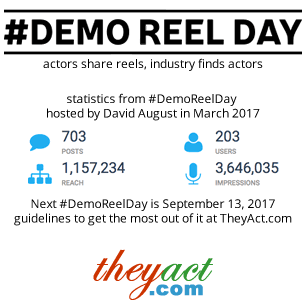
The next #DemoReelDay is September 13th, during episodic season. On #DemoReelDay, uploading your reel directly to Twitter will make it easier for industry to watch it, and for your reel to be a part of other features like moments. End sidenote.
Today, I'll touch on YouTube captions and uploading your demo reel to your Facebook page.
YouTube takes a little while after uploading a video to make automatic captions, their computers' best guesses. Here's how we make captions work for us:
- Correct and replace the automatically generated captions. I used their built-in tool for this.
- Watch your demo reel, with the captions on, to make sure they are right. We are helping search algorithms and people who can't hear the video understand it with captions inside the video.
- Download and save the .sbv file of your YouTube captions. This file will be useful for uploading elsewhere, like Facebook, and you don't want to lose all your work making them right.
Now to upload it to your Facebook page (not your personal profile, but your fan page). I posted mine in a post like this:

And here is how we make it work for us:
- Upload the same video file you uploaded to YouTube.
- Fill out the fields on the basic tab, and add a custom thumbnail. I used the same thumbnail image file I used on YouTube.

- In the Captions tab, you'll need to upload your captions from step 3 above as a .srt file. Use a website that can covert your .sbv captions file into a .srt captions file. Facebook may complain about your .srt file unless it is named [filename].en_US.srt (I'm assuming your reel is in American English, if it isn't and you want guidance for yours, let me know).
- Don't need to do anything with the Advanced or Crossposting tabs.
- Watch your demo reel, with the captions on, to make sure everything is right. We are helping people and machines understand your video, and captions will display when people are scrolling through their Facebook feeds, making it immediately more intelligible.
That should put your demo reel on Facebook in a pretty good way. Hope this helps and let me know if you've any questions in the comments, on Twitter, or something like that. Good luck!
Labels: acting, technology, trends, youtube
this posted by David August at 6:01 PM - 0 comments -


