Wednesday, July 23, 2025
As of 2025, please go to stuff.davidaugust.com, my newer blog. See you there!
Please join me at stuff.davidaugust.com now.
I am now post to stuff.davidaugust.com and this blog is being decommissioned. Please change your bookmarks, links and feedreader settings. See you there!
Labels: technology, trends
this posted by David August at 11:58 AM - 0 comments - 

Saturday, May 20, 2023
As of 2025, please go to stuff.davidaugust.com, my newer blog. See you there!
Being Human in the Age of AI
being human is big, bigger than we usually think it is

There is a lot of talk about artificial intelligence (AI) doing as well or better than humans at things. Machines have long out-performed people at a lot of stuff. And this doesn't just apply to complicated machines like cars, but simple machines, like a lever, have long amplified or done better than us. A pry bar is better at prying things than our bare hands. But humans have not, ever since the first person used a rock to make their efforts easier, been made obsolete by the machines we've made.
Sure, some things we have machines do that people used to do. But humans haven't stopped existing because of this. If anything, machines have allowed us to grow: machines and technology are part of why there are more humans currently alive than there have been at any other point in history. Humans haven't been made obsolete by tech.
So why is AI disrupting things typically done only by humans? Things like writing, art making, film-making and acting are starting to be threatened by systems, artificial intelligence (AI) systems. Why isn't it pry bars and not artists? Life and limb.
A self-driving car getting things wrong immediately collapses into the tyranny of atoms: concrete and often irreversible consequences come when a machine driving itself ends a life, or ruins someone's property. While self-driving vehicles may get to the point they are safer than human drivers, they will never be perfect, and this imperfection when matters of life and limb are involved, makes them hard to cheer for or even experiment with out in the real world.
Not so with media, entertainment and the arts. Artistic creations made by non-humans don't leave grotesque consequences if they fail: any bad movies, books, music and more made by artificial-intelligence (AI) will fade into the noise floor of un-celebrated human artistic attempts. No life or limb is imperiled if an artificial intelligence (AI) made film falls flat, instead bank accounts and careers get impacted (and disappointed audience).
This lack of life and limb involvement can make creative and artistic endeavors feel like the "consequence-free" world of software and web development: as if one can fail quickly and iterate in order to experiment in public and refine as one goes. However, the context of software and any context where life and limb are in play react very differently to things if one tries to fail fast. Experimenting and learning are invaluable, but at scale and in public, the tyranny of atoms makes doing so with self-driving vehicles, autonomous weapons and other life and limb scenarios far more dire than an unpleasing painting or a film that flops at the box office.
While many life and limb contexts benefit from the fact automated and artificial intelligence (AI) systems don't suffer from fatigue, emotional compromise or inebriation, some of the same things that drive humans to be tired, emotional, or otherwise not consistent are vital to make good decisions in other ways. Logical decisions with zero emotion can be low quality decisions (there are studies suggesting this is true, but they are beyond the scope of our discussion here).
Artificial intelligence (AI) promises the benefits of intelligence with none of the "downsides" like inconsistency or asking for a paycheck. Taking humans out of the loop may be possible, even beneficial in some contexts. But imagining an artificial system will benefit from all the strengths we take for granted in humans (or even see as liabilities) seems a mistake. Human are imperfect according to humans. What we find desirable and what the universe has evolved us into for our survival as a species are not the same. Eugenics makes many errors, this is one among them. Humans are great at a lot, even things we don't think of as great.
Being human includes the foibles and messy parts. It's not pre-Copernican to suggest that humans, after millions of years of evolution, are excellent at being human. This includes messing stuff up, hurting ourselves and also creating great things, beauty, connection, grace, mercy, cruelty: all of it. To imagine in the space of a few years or decades one can do what has taken billions of people filtering through millions of years of evolving is the magical thinking here. To fall so I love with human ingenuity and creation as to believe in a few generations time we can out create the forces of evolution over the timeline of geologic epochs, that is feeling to me like the fallacy in this.
Yes, AI can do, and maybe even excel at, specific human-like tasks. The question of what is necessary and sufficient for something artistic to be art, what is the essential that makes art in fact art is an entire branch of philosophy. There is little consensus on this, and what makes art human, or what human component is necessary for something to connect and resonate may not have consensus either. That said: I think saying there is an X factor, some amorphous and undefined thing, that is a cop out.
The generative AIs, both images and text, are sophisticated mirrors. Highly complex yes, but basically reflecting back their prompt and their training data is all they're actually doing. Often compelling enough for us to forget this, but that is what is happening even if the results feel like more.
So here goes:
It is the vast and minute combination of human intuition, rationality, emotion, fear, power, weakness, apprehension, insight and ignorance. At the risk of paraphrasing the dignity of man speech in Hamlet, we might sum it up as the human condition.
Wikipedia, a source of common meanings, sums the human condition up as "the characteristics and key events of human life, including birth, learning, emotion, aspiration, morality, conflict, and death." Mortality and love (not just romantic love) certainly seem to figure in to what I think the condition of being human includes. And how love and mortality figure into making art, or any creation in a way, is somehow uniquely human. We can probably spend a long time and many words defining, describing and discussing this.
For our purposes: knowing we will die perhaps underscores all our actions with a fleeting immediacy, even if that immediacy is an undercurrent and not the focus of what we do moment to moment, day to day. Does a machine have a functional life? Of course. But none of its activities are filtered, really in any way, through a lens of that mechanized mortality. Even in the back of our minds, under our awareness, the fact we may stop existing does inform in both subtle and bold ways how we do what we do.
Fictional characters are often revealed by how the do what they do. In many ways, how we do what we do is who we are. How the character says what they say, matters almost as much as what they've said. I leave the studies on non-verbal communication dominating the information exchanged between people for others to detail elsewhere.
How someone lifts a coffee cup can speak volumes about them, what they have done, are doing and will do. Does the way they lift it reveal the old injury from their time in a past captivity? Do they lift it in preparation to enjoy a moment's respite from current stress? Are they preparing to go without coffee as they are due too enter a coffee-less meeting? All of these options and a myriad more impact how the simple act of lifting a cup of coffee happens. They can be revealed and communicated in many ways like how quickly, slowly, angrily, happily and a bunch of other details that we all notice, even if not consciously.
And this rich, deep, full bodied (pun intended) action and all it communicates (literally, emotionally and maybe even spiritually) happens on some level even from this mundane act of picking up a cup of coffee. It can be filtered (pun intended again) through the whole of the human experience of the person lifting the cup, and also through the whole of the our human experiences as we witness it. With varying levels of awareness and attention, our neurology encounters and interprets what we behold in a rich amalgam of ways that help us understand, cognitively and otherwise, the world and those in it.
If all of this can easily become an overwhelming, almost unmeasurable amount of "data" were we to try to digitize it. Both the actor and the viewer are effected by it all and in turn effect the interaction in so many ways.
To imagine that we, in a handful of years, will be able to do this with a machine is folly. To replicate or emulate with a machine (let alone innovate) such a deep and complex moment as raising a cup of coffee is a little bit of hubris.
What's that you say? An mp3 compresses sound to about a tenth the size (in data) of what CD quality sound takes up by trying too remove what the algorithm imagines (was designed) to think we won't miss. And mp3s still give us the emotional and other impacts of the higher quality sound file? Our music on our phones and streaming services is still music, right? Yes, but if something walks like a duck, quacks like a duck and isn't actually a duck it still matters if it isn't a duck. And some people do consciously hear the difference between an mp3 and CD quality music. The rest of us unconsciously hear the difference (studies of galvanic skin response suggest different audio qualities and film frames rates effect us differently physiologically).
Why does that matter? Because there are many things the simulacrum (the simulation or reproduction) of things do not have that the actual things do have. People still flock to see the Mona Lisa despite reproductions, even very high quality and faithful reproductions. Those reproductions may have a "better" viewing experience than traveling to Paris and dealing with crowds. Is that some sort of fame fetish, or placebo effect? Maybe.
The fact remains: when we have had whatever day we have had, and crave the comfort of stories, we often yearn to have humans help us make sense, not just of events, but of our own experience, emotions and spirituality from the day. We have done this as long as we have done anything, even if at first it used to only be around the embers of a fire in caves long ago. Now we use tech to send reproductions of people to the far reaches of the globe, but the purpose and our need for it is the same.
If people still care about an original painting made centuries ago, can we really assume they won't care about original people on screen made now? Can our creation with only artificial intelligence (AI) really out human our ability to human? No. It can enhance, stand-in-for and supplement humans. Much as shoes do for more the fragile soles of our feet than going barefoot does, so too will artificial intelligence (AI) allow us to do new things. And like shoes, or a pry bar, or any other technology, artificial intelligence (AI) will change things, even in ways we can't yet guess at. But it seems deeply unlikely any artificial intelligence will somehow, inexplicably, transcend the makers of it.
What feature could allow any digital or electronic system to suddenly cross the threshold of passing from not human to beyond human? Since we don't agree on what being human is to begin with, we may not even be able to measure or meaningfully discuss when something we have made is more us than we are.
Our imagining we already consciously understand the what and why of how we connect with humans and human stories may be the big fallacy of this. Can we make something that imitates human stuff? Probably. We can probably even make imitations that we will believe are the real thing, at least in some contexts. Will this somehow become better at being human, whatever that means to us, than humans are? Probably not. Whatever our weaknesses and strengths, we probably aren't going to buck or defy our own natures enough to make a more human-than-human non-human.
Labels: acting, artificial intelligence, entertainment, film, technology, trends, tv
this posted by David August at 5:20 PM - 0 comments -
Friday, November 18, 2022
As of 2025, please go to stuff.davidaugust.com, my newer blog. See you there!
How to Find Your Twitter People on Mastodon
people you follow on Twitter may be on Mastodon and you can find them

Trying to find people you connected with on Twitter here on Mastodon is complex right now.
I'm using the three tools to try to get people's handles over here on Mastodon off of Twitter. All of these are a little unstable right now since so many people are using them at once.
- https://twitodon.com/
You log into both your accounts with it, let it work, and then can download a file you can then upload to Mastodon to follow people. The catch: those people need to have used it too. - https://pruvisto.org/debirdify/
Lets you basically scan your Twitter folks profiles to see if they've left a Mastodon forwarding address for people. Then you can download a file you can then upload to Mastodon to follow people (or manually look through, which I recommend). The catch: if might get things that aren't actually Mastodon addresses, or their colleagues info scooped up instead. - https://fedifinder.glitch.me/
Like Debirdify (number 2 on this list), it scans your twitter folks profiles over there to try to find their Mastodon handles. It also download a file you can then upload to Mastodon to follow people (or manually look through, which I recommend). The catch: it also might scoop up stuff that isn't actually a Mastodon addresses, or their colleagues info.
So far, there is no single, easy way to migrate. That is kinda what happens when a single company with 7,500 employees keeping things working is no longer involved. Disappointing, but Mastodon can be an alternative and stop-gap right now; Mastodon may be able to grow into a more resilient option than Twitter or any other run-by-a-single-company social network ever has been. Right now, much of Mastodon is just struggling to accept the huge number of new people using it. Patience is probably a good plan. Good luck, and let me know if I can help you. I'm @davidaugust@mastodon.online on Mastodon and have other links on my linktree, and should always be findable through davidaugust.com.
Labels: acting, mastodon, technology, trends, twitter
this posted by David August at 12:24 PM - 0 comments -
Monday, November 07, 2022
As of 2025, please go to stuff.davidaugust.com, my newer blog. See you there!
Posting Tweets to Mastodon
automatically have your Twitter post to your Mastodon
So maybe like me you're thinking of diversifying your social media presence beyond Twitter and onto Mastodon. I don't want to have to manually post on both right now, and it is too early to focus just on Mastodon since most of the people I connect with not there yet, they're still on Twitter. I want to build for the future now by posting my tweets on Mastodon.
One way to build a presence on any new site is to have what you post on an old site get posted to the new one automatically. That's where a tool that posts your tweets on Mastodon for you comes in. I was going to try 3 tools to automatically post my Twitter on my Mastodon, and review them all. But the first I tried seems to do the job; I haven't needed to see how the others work. I'll stay with it unless the first one goes offline or stops working. I'll mention the other two here in case when you read this one of them is a better solution.
Without getting too technical, these tools will check your twitter for new tweets, and then post them on Mastodon for you, automatically. That is what's supposed to happen; unless something breaks or goes offline, it should work as designed once it is set up.
Mastodon is not a central company, so everything that runs on Mastodon may not always run as smoothly as a commercial product. Mastodon also does not have a single place to seek answers if you need help or support. Your mileage may vary. So far things often load more slowly with Mastodon than they do with a site/app like Twitter that is run by one company.
Not every Mastodon tool will work with every other Mastodon tool and instance. Instances are what Mastodon calls the servers that run it. They are run by different people, unlike Twitter which is run by a single company. These different servers, instances, can talk with each other. That lets a post (Mastodon calls posts "toots") on one server be read and interacted with by people on other servers. This can delay things. Sometimes if a server is down or out of communication, then the delay can be more than a few minutes.
Every Mastodon server being run by different people can also mean their policies can be different. Different Mastodon servers allow different types of content sometimes, and each have their own privacy policies. The good news here is that there isn't a business model of Mastodon gathering and selling personal information. In fact, there is no single business model behind Mastodon. It is more a protocol than a company or product. Mastodon is like a way you to do what you have always done on social networks, except without single central company running it. It is more like software than a single service.
Here's how to post your Twitter posts on Mastodon.
Mastodon-Twitter Crossposter
The first tool I tried using to send my Twitter feed to Mastodon is the Mastodon-Twitter Crossposter and I set it up at https://crossposter.masto.donte.com.br/. It was recommended to me and seems to work well.
Upsides:
- It can post both ways, Twitter to Mastodon and Mastodon to Twitter. I have only tried having it post my tweets to Mastodon, not the other way around.
- It can post images you post on Twitter on to Mastodon too (not sure if it can do this the other way, but it probably can).
- The developer seems to be actively connecting with Twitter to make it work well; they mention talking with Twitter support as recently as two days ago.
Downsides:
- None yet.
Moa Party
I have not yet used this tool (at https://moa.party/), but Martin Fowler, whom I do not know personally, does and says his Mastodon-aware colleagues have used it without problems.
Linky
Linky is an iOS app (at https://pragmaticcode.com/linky/), that is intended to "Post to Twitter and Mastodon with simplicity." It may or may not automatically post from one to the other. It might be more about posting directly to your Twitter and Mastodon easily from your iPhone of iPad.
IFTTT
IFTTT is a service/site/app that allows many different websites, apps and devices to interact and do things automatically. They do not currently have a publicly available applet (what they call the small piece you can configure to do stuff for you) that will post from your Twitter to Mastodon. If you are open to some coding/technical configuration, you can make yourself a IFTTT applet to post to Mastodon from Twitter (or anywhere else). If you don't already feel comfortable using webhooks, or know what a webhook is, this may be a bit of a learning curve.
Please let me know if you have any thoughts or questions. My current links can probably be found on my linktree or at davidaugust.com. And I’m now on Mastodon at @davidaugust@mastodon.online too.
Labels: acting, mastodon, services, technology, trends, twitter
this posted by David August at 3:14 PM - 0 comments -
Friday, March 20, 2020
As of 2025, please go to stuff.davidaugust.com, my newer blog. See you there!
Netflix Support for Their Employees
Netflix is putting $100 million dollars toward helping their employees present and future through the difficulties of the Coronavirus pandemic.
Beyond helping workers on our own productions, we also want to support the broader film and television industry. So $15 million of the fund will go to third parties and non-profits providing emergency relief to out-of-work crew and cast in the countries where we have a large production base.
In the United States and Canada non-profits already exist to do this work. We will be donating $1 million each to the SAG-AFTRA Foundation Covid-19 Disaster Fund, the Motion Picture and Television Fund and the Actors Fund Emergency Assistance in the US, and $1 million between the AFCand Fondation des Artistes. In other regions, including Europe, Latin America and Asia where we have a big production presence, we are working with existing industry organizations to create similar creative community emergency relief efforts. We will announce the details of donations to groups in other countries next week
(from Emergency Support for Workers in the Creative Community).
Labels: money, technology, trends
this posted by David August at 6:52 PM - 0 comments -
Saturday, March 14, 2020
As of 2025, please go to stuff.davidaugust.com, my newer blog. See you there!
Why the News Is Scary
Sometimes, our interconnected-ness, all by itself, can distort the world.
Now let's get a handle on what it really means to have a 1-in-6,500 or a 1-in-13,000 chance of dying. It's as if you lived on an island in the South Pacific with a population of 650. You make your living by swimming around in the azure waters around your idyllic paradise and spearing fish for dinner. Yum, yum. About once every ten years, a stray shark happens by and eats a swimmer. That's a 1-in-6,500 chance of any one person being eaten by a shark, just the same as the odds of dying in an automobile accident in the U.S. in 1992.
Also, about once every 20 years, two men get into an overheated argument over a fish or a woman and one of them kills the other with his spear. That's a 1-in-13,000 chance of being killed in an argument, just the same as the odds of being killed by someone else with a gun in the U.S. in 1992.
These are very sad events, and probably dinner-table conversation for quite a few days, but not the be-all and end-all of life. Fortunately, since you live on an isolated island, these events come and go, and life goes on.
But now imagine there are 392,000 of these islands all linked by television and INN (Island News Network). This brings the total population to about 254 million, less than the U.S. today. Every night, INN reports on the goriest of the 107 shark attacks and 54 spear deaths that day. Suddenly people's picture of the world is quite different. From a peaceful existence disrupted only by a tragedy every few years, you go to a fear-ridden hell filled with crime and terror.
Isn't this interesting? Nothing has changed except the addition of television. Yet now it feels like you're living in a dangerous world, not an idyllic paradise. Same number of shark attacks, same number of spear deaths. What happened?
(from about page 247 of Virus of the Mind: The New Science of the Meme by Richard Brodie).
Labels: news, technology, trends
this posted by David August at 8:08 AM - 0 comments -
Tuesday, March 20, 2018
As of 2025, please go to stuff.davidaugust.com, my newer blog. See you there!
How To Self-Tape Auditions (According To a CD)
CD Billy DaMota shares his advice on self-taped auditions:
Been watching self-tapes all day...
So I thought I'd add my 2¢
Some pretty simple rules that I can see. Add more if your think they make a difference in the way self-tapes are considered.
- iPhone (anyone who spends $700+ for a camera to self-tape is a moron). And you can get an iPhone tripod for as little as five bucks on Amazon [may be closer to $15].
- Make sure your face is well-lit.
- Make sure they can hear you (avoid noisy environments).
- Wear a character-specific outfit. Homeless? Attorney? You get it.
- Framing? Depends on what your action is. Always. You can't do "chest up" framing if your action is "a chant in the lotus position" or "Elvis grinding while playing guitar."
- Follow the CDs instructions (props, direction, number of takes, how to slate, etc.).
No need to edit. Shoot it, review it, save it and send it. The only other suggestion I'd give is to state at the end of the tape or in the notes with your submission that IF they like what they see but want to redirect you, you can get them a redirected self-tape within hours. The biggest problem I run into is seeing actors who are SO good and SO close, but who need a minor tweak I know the director would like...and I can't do that with a self-tape!
What I see with most self tapes I get is that actors are thinking too much about the production value and not enough about the performance. I will always forgive you for less-than-perfect production value; you will not be forgiven for a mediocre performance.
So.
Have fun, make it your own, and if you don't like what you've recorded...do it again until you're happy.
There you have it, one casting director's take on self-taped auditons. If you'd like acting coaching for your auditions, let me know; break a leg!
Labels: auditions, process, technology
this posted by David August at 1:45 PM - 0 comments -
Thursday, August 10, 2017
As of 2025, please go to stuff.davidaugust.com, my newer blog. See you there!
Fearful Legal Departments Run Amuck
Studios: we're gonna pull our stuff off your service; we don't want you to have too much power.
Streaming service: ok... I guess we'll make our own stuff.
Studios: 'cause you're making your own stuff, we're worried you have too much power; we're gonna pull more of our stuff off your service.
Everyone: 😳
You really can create your own competition and then lead them to destroy you, if you try.
Labels: money, technology, trends
this posted by David August at 1:43 PM - 0 comments -
Tuesday, June 13, 2017
As of 2025, please go to stuff.davidaugust.com, my newer blog. See you there!
June Gloom Means Good Filming
"June Gloom," is a good chance to take advantage of the natural diffusion and longer daylight that nature provides right now, and film things with your smartphone.
Have good shoots, and share with me what you end up getting shot. Maybe put it on your reel and share it on #DemoReelDay too.
Labels: acting, technology
this posted by David August at 10:01 AM - 0 comments -
Wednesday, April 12, 2017
As of 2025, please go to stuff.davidaugust.com, my newer blog. See you there!
Demo Reel Captions on YouTube and Facebook
You should add captions your demo reel on YouTube and put your demo reel on Facebook in a good way. Uploading your demo reel video well is your last mile, your last step, of getting your work where it needs to be. If your demo reel (or showreel if you're from the British Commonwealth) is uploaded well, then it can to lead to good things for your career.
Today I'll focus on YouTube's captions and uploading to Facebook. I can delve into other areas, like demo reel titles and descriptions another time. I can also cover other places, like casting sites, another time if you'd like.
Sidenote: in 5 months you'll want to know how to post your reel on Twitter so you can be a part of the #DemoReelDay event I created and host. #DemoReelDay is a great free chance for actors' work to get seen. Last month's #DemoReelDay, during pilot season, had great success: agents, casting directors, producers, and multi-hyphenates watched our reels, engaged. New friendships, collaborations and fresh connections were forged on the first #DemoReelDay March 29, 2017:
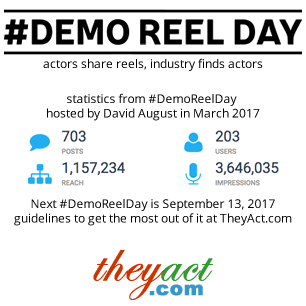
The next #DemoReelDay is September 13th, during episodic season. On #DemoReelDay, uploading your reel directly to Twitter will make it easier for industry to watch it, and for your reel to be a part of other features like moments. End sidenote.
Today, I'll touch on YouTube captions and uploading your demo reel to your Facebook page.
YouTube takes a little while after uploading a video to make automatic captions, their computers' best guesses. Here's how we make captions work for us:
- Correct and replace the automatically generated captions. I used their built-in tool for this.
- Watch your demo reel, with the captions on, to make sure they are right. We are helping search algorithms and people who can't hear the video understand it with captions inside the video.
- Download and save the .sbv file of your YouTube captions. This file will be useful for uploading elsewhere, like Facebook, and you don't want to lose all your work making them right.
Now to upload it to your Facebook page (not your personal profile, but your fan page). I posted mine in a post like this:

And here is how we make it work for us:
- Upload the same video file you uploaded to YouTube.
- Fill out the fields on the basic tab, and add a custom thumbnail. I used the same thumbnail image file I used on YouTube.

- In the Captions tab, you'll need to upload your captions from step 3 above as a .srt file. Use a website that can covert your .sbv captions file into a .srt captions file. Facebook may complain about your .srt file unless it is named [filename].en_US.srt (I'm assuming your reel is in American English, if it isn't and you want guidance for yours, let me know).
- Don't need to do anything with the Advanced or Crossposting tabs.
- Watch your demo reel, with the captions on, to make sure everything is right. We are helping people and machines understand your video, and captions will display when people are scrolling through their Facebook feeds, making it immediately more intelligible.
That should put your demo reel on Facebook in a pretty good way. Hope this helps and let me know if you've any questions in the comments, on Twitter, or something like that. Good luck!
Labels: acting, technology, trends, youtube
this posted by David August at 6:01 PM - 0 comments -
Wednesday, February 08, 2017
As of 2025, please go to stuff.davidaugust.com, my newer blog. See you there!
Direct Deposit Residual Payments
Delivery of residual payments via direct deposit will finally become a reality in 2017. The program will begin with select payment partners and our eventual goal is to offer electronic processing of all residuals. This new service will not only add much-needed efficiency to the financial lives of performers who depend on these payments, but will also be another major step in SAG-AFTRA's eco-friendly green initiative
(emphasis added, from Game-Changing News). This seems like a very good thing.
Labels: acting, money, technology, trends, unions
this posted by David August at 2:58 PM - 0 comments -
Friday, January 27, 2017
As of 2025, please go to stuff.davidaugust.com, my newer blog. See you there!
3D TV Is Not a Thing Anymore
There are no more major TV-makers that make 3D TVs anymore
(from 3d TV is dead). Seems our work will not be soon be seen in 3D at home, unless VR gets in-home traction. Movies may still be coming out in 3D for a while, whether they are shot natively that way or converted in post. The 3D up-charge has a real impact on box office returns, and some stories are well suited or work better in three dimensions. There are some people who like having the spectacle of 3D, and some who don't.
Labels: technology, trends
this posted by David August at 3:35 PM - 0 comments -
Monday, November 14, 2016
As of 2025, please go to stuff.davidaugust.com, my newer blog. See you there!
Filter Bubbles Change Outcomes (or Facebook EdgeRank Is Flawed)
disclaimer: It's 2:45 in the morning. Insomnia has me thinking wildly, and this may not be good logic, or reasoning, but here goes (caveat lector).
Facebook, and other systems (like Google's search results) insulate and cut us off from people who think differently than we do. This is bad, for many reasons. It polarizes us and leads to bad outcomes for everyone. This filter bubble problem was pointed out at least 5 years ago, and this problem continues and increases today.
To believe that Facebook did not accidentally affect the election with hoax stories may be to misunderstand math, or to forget that small things are still things. Not understanding math is something Mark Zuckerberg cannot believably claim. Hoax stories shared on Facebook probably impacted the election results. An impact can be small, but also be real, and maybe even decidedly so.
EdgeRank is the part of Facebook that chooses what you are shown in your Facebook newsfeed. If EdgeRank decides not to show a post to you in the newsfeed, you have to manually go to someone's page or profile to see the posts; posts won't show up on the newsfeed for you unless EdgeRank puts them there. On average only about 16% of your friends or fans will be shown a post (unless you pay to promote it).
Some at Facebook claim that EdgeRank didn't have any impact on the election. But small things can make a big difference.
On Saturday night, Mr. Zuckerberg posted a lengthy status update to his Facebook page with some of his thoughts on the election.
Of all the content on Facebook, more than 99% of what people see is authentic. Only a very small amount is fake news and hoaxes,Mr. Zuckerberg wrote.Overall, this makes it extremely unlikely hoaxes changed the outcome of this election in one direction or the other
(from Facebook, in Cross Hairs After Election, Is Said to Question Its Influence).
Small does not mean unimportant. It could even be that such a number, the type of number Zuckerberg is dismissing, could change major world events.
Under 1% is a very small amount. 0.52% is a more specific small amount. Somewhere under 1% of stories on Facebook, according to Zuckerberg, are hoaxes. 0.52% is, According to AP, the difference between the number of votes Hillary Clinton got and Donald Trump got (as of November 13, 2016, AP has Donald Trump getting 60,350,241 votes and Hillary Clinton getting 60,981,118).
I am not calling Mark Zuckerberg wrong, but Facebook is calling Mark Zuckerberg wrong. Facebook says people do things based on what's shown to them in their Facebook stream:
Because Facebook Ads are placed in the [news] stream of information people view on Facebook, they’re more likely to see your ads and take action
(emphasis added, from Facebook business: Facebook ads retrieved November 14, 2016).
Facebook tells their paying customers that people act on what they see in news streams on Facebook. Zuckerberg says less than 1% of those stories people act on are hoaxes. Could 0.52% of those stories be something people acted on recently ;-).
For us as actors (and this post is decidedly not focused on our work, but more our online lives), EdgeRank is the machines choosing who sees what we post, including pictures and videos. Machines are not great at programming our work like the artistic director of a theatre or the cinema owner or the traffic department of a TV network (traffic as in what's on air, not what's on roads). It would be nice if everyone who would be thrilled to see our work we share would be shown our work, but no machine in the world can curate that well. Right now EdgeRank, or spending money to promote imperfectly (Facebook sometimes promises a wider reach than a spend will actually give) is all Facebook allows.
If Facebook wants to improve EdgeRank, including some of the posts we don't typically interact with in the news stream is a straightforward option. Remember: liking, sharing or commenting a post is the only data EdgeRank uses. To imagine people don't want to see or aren't affected by posts even when they don't like, share or comment is to imagine human behavior can be reduced to 3 types of database entries. It can't be. That's not even mentioning all the things we do in life that aren't strictly behavior. But this ventures into human-computer interaction, engagement measurement and metrics, and all are probably best for another post on another day...or night. Right now: good night!
Labels: technology, trends
this posted by David August at 2:56 AM - 0 comments -
Friday, October 21, 2016
As of 2025, please go to stuff.davidaugust.com, my newer blog. See you there!
1880 Compliant
I coined the phrase 1880 Compliant
or 1880 Compliance
to refer to things that will still work, or keep working, if the power grid goes down. "Compliant" as in goes along with or works with, and "1880" because the first commercial power generator went online in about 1881. It's like a shorthand for business continuity without electricity: what happens if the power goes out? What happens if the power stays out? Actors are small businesses. Anything 1880 Compliant is a thing that works whether or not the power is working.
Important deadlines and other things don't care what infrastructure is doing in your area; you either showed up for work, or an audition, or you didn't. You could download the script/sides, or you couldn't. The movie/video/1880 Compliant
for years, but today I'll commit it to (digital) paper. Seems kind of apt. And ironic (not quite what that word means, but I digress).
Something you or a business does is 1880 Compliant
for some amount of time. Books printed on paper are 1880 Compliant forever, books on a digital readers are 1880 Compliant for the life of the battery: they're basically not 1880 Compliant at all or are for only some hours or minutes.
Things that are 1880 Compliant can include:
- A paper date book
- Unless you lose it, burn it or otherwise physically destroy it, a paper date book will be available, complete and serve its purpose until the paper rots away. It won't care no what the power company does.
- A bicycle
- If it works today it will likely work tomorrow and the next day. Eventually its maintenance may need things like replacement parts and lubricants, and those need power to be available where you are, but a bike is effectively 1880 Compliant for the foreseeable future.
- Talking in person
- Face to face conversation doesn't require electricity to happen, and if the people's basic survival needs are met (the modern world requires electricity enabling the technologies that make food and clothes that end up in our presence), they can effectively communicate like this for the rest of their lives.
Things that are _not_ 1880 Compliant could include:
- A digital planner
- If you can't charge its battery it won't help you know what's next or next week. And if you think an online or home back-up will save you, you are right-ish: those will extend its 1880 Complaint time-frame, and may make your schedule retrievable, but eventually all those 1s and 0s do nothing for you if the power doesn't come back on soon.
- A car
- You may think "but I don't have an electric car, my car uses gas," and while that can be true, surprisingly almost all gas stations use electrically powered pumps without a petroleum product powered generator as back-up. Despite the distribution and sale of petroleum products being almost the entire business model of a gas station, they depend on the power being on. This means that in many natural disasters people have been left to abandon their cars and walk, even if they are right next to a gas station that has underground storage tanks full of fuel. That fuel is totally out of reach because the station's pumps rely on power that is not available. Remarkably foolish and tragic: this lack of a generator back-up slowed evacuations after the storm surge knocked out power before Hurricane Katrina made landfall.
- All communications with screens or microphones involved
- Kind of obvious; electrical technology may work during a power outage at first, but eventually telephone and cell phone systems' back-ups will run out of their ability to keep things running if the power grid stays down long term.
As actors, when working on a film or TV set, the production may have brought its own generator and may then be able to keep working without interruption for a time. They may be able to keep filming and "make the day" without the local power grid providing electricity; a set might be 1880 Compliant for some hours. Our work certainly doesn't require electricity to be done, though the systems that capture it and all the people working on the shoot probably will eventually need power from the grid to work well or at all. Plus, if the power went out because of anything that wasn't limited to the power grid (like a storm or other natural disaster) then filming probably stopped for other compelling reasons.
On stage, the show probably won't go on with out the power on; most theatres don't seem to have backup systems to power everything for hours if the power goes out. The light board and sound systems may have backups for their computers, but the lights, lobby and ticketing areas are probably going to go dark and stay dark. Rehearsal might be able to happen, in a park or a space with windows during the day, and auditions maybe could too, but with out the power up, traffic signals and subways probably don't work so getting to a rehearsal or audition might not be possible. A lot of what we do for work doesn't work when the power doesn't.
A corollary I'll mention that I also coined is one can be 1980 Compliant
, meaning working without internet connectivity. The internet wasn't widely adopted until after 1980. Now I'm off to go to an 1880 Compliant in-person meeting ;-).
Labels: technology
this posted by David August at 12:34 PM - 0 comments -
Thursday, October 06, 2016
As of 2025, please go to stuff.davidaugust.com, my newer blog. See you there!
Let's Make a Content!
The world has embraced the word "Content" for much of what we make. But that puts so much emphasis on the container and so much less on the things contained. I am starting to use the word "material" more to myself, to clarify that what we make has value and worth even separated from the container it comes in.
"Material" can be made into stuff. "Content" is bland and emotionally agnostic. My friend Shariq Siddiqui (with whom a conversation today inspired me to actually write out this post, a post that had been tumbling around in my mind for a while now) said, people don't wanna pay for content (even if they'll pay for anything around it). Material makes it sound like...well...material!
Maybe we start thinking of our film and TV work as more like material making its way through a digital mill towards the audience. And think of it less like some blank feature-less chunk of content being digitally shipped in uniform shipping-container-like units toward the viewer or user.
But "the medium is the message" rings true in so many instances, so no matter what's said, we all notice the way and place it is being said. But, I connect with the character more than the logos at the start of the show or movie, and I think you do too. That is how we all want it. That is how we expect it to be.
I'm suggesting we don't get bogged down in focusing on the "container," the "pipes," the "screen," or, heaven forbid, the "bucket," and lose sight of the reason those things exist. They were created in the first place to serve content, both to be of service to it and to deliver it. Stories of human life need to be kept somewhere. The people and the stories can live without the containers (ex: live stage performance), but the containers and outlets kind of become pointless without the people and stories.
Not sure we'll find ourselves calling a friend and saying: "let's make a great content!" But whatever we call it, let's make some great things.
Labels: inspiration, process, technology
this posted by David August at 5:33 PM - 0 comments -
Wednesday, August 10, 2016
As of 2025, please go to stuff.davidaugust.com, my newer blog. See you there!
TV Show Lengths Could change
You're also going to see the clock for linear channels [think broadcast and cable television, traditional television] change dramatically. A show could be 10 minutes, seven minutes, 94 minutes. We just need to tell the stories that need to be told
Says Nancy Dubuc, the President and Chief Executive Officer at A+E Networks (from TV Titans Roundtable: 5 Chiefs Spar Over the Future (and Netflix's Role as Arch-Frenemy)). This suggests that in the not-too-distant future, shows that now are online only could migrate to more traditional TV places. Exciting.
Labels: money, technology, trends
this posted by David August at 4:41 PM - 0 comments -
Friday, May 20, 2016
As of 2025, please go to stuff.davidaugust.com, my newer blog. See you there!
The Last Mile
The trailer was riveting, and then it just stopped. The bit of the video that is normally loaded ahead of what you are currently seeing on the screen, the buffer, had gone empty. The pace of the scene, gone, the flow, now missing. Now the player was trying to find the data somewhere online from a machine that wasn't replying fast enough for anyone to watch it. See, people don't realize that it takes time to send things great distances online. And this video player clearly didn't understand it. Or more accurately, it hadn't been designed to load more into the buffer before it started playing, so it wouldn't run dry. And this trailer, and the actors in it, are paying a price for it.
This is the last bit of our work: it getting to the audience. This last bit, "the last mile" as the telecommunications industry calls it, is expensive. In the theatre not so expensive on the day it happens, but may have been in training. In theatre, the last mile is up to us: we find our light and speak clearly and distinctly enough for the last row to hear the words. In film and tv it isn't in our control unless we are the distributor (like when we put our work online ourselves). There are people who dedicate their careers to making sure broadcast tv or movie theatre prints and digital files are technically perfect. And there are engineers who build screens and projectionists who run them to insure our work makes it past this last mile.
But there are other versions of the last mile. Getting things across the finish line, to a point of completion is vital. Get a script into a shareable form, move an edit to a picture-lock status, finish a sound mix, get a project to a point of being finished, meaning it is now in the audience's minds and hearts. If our work doesn't get there, we may as well have just been rehearsing.
An additional side note: there is a reason certain video web sites are as ubiquitous and well known as they are. Well actually there are probably many reasons, but the one I'm focusing on here is this: the site by and large works whenever we, or the audience, go to it. And the site works because they spend a small fortune making sure that last mile is handled well. For instance, one major site once gave $300,000 bonuses to every one of their employees who worked on a system that stores often watched videos on the servers of your internet service provider (basically the machines near what your computer/tablet/phone connects to first) instead of further from you on their own servers in their own data centers. What this means is, if you have any say in how something you are in is going to be shared online, don't fall into thinking the off-brand site with a poorly set up player and network won't kill your project before it's even been born. Use what works. It is sad to see good shows and movies languish and disappear into irrelevance because the last mile was ignored. So please, follow through, and get your projects across the finish line. Otherwise, I fear we are basically hobbyists.
Labels: technology, trends
this posted by David August at 6:10 PM - 0 comments -
Wednesday, September 16, 2015
As of 2025, please go to stuff.davidaugust.com, my newer blog. See you there!
What's Old Is New Again: Antitrust
70 years ago, movie studios could own movie theatres. And they did. They could fill them with whatever films they wanted, like their own movies they made themselves. The ownership of everything from the beginning of the production all the way through the final sale to the end consumer (vertical integration) means lots of money and control. Never letting any competition in, or dictating terms to them, can be good for your short term bottom line.
In 1948, in US v. Paramount, the Supreme Court said it was no longer ok for studios to own the theatres too. That's why today they by and large don't. Or do they:
Giant-screen specialist IMAX Corp. is joining the content creation party, and will be generating its own movies and other programming in the near future, the company’s entertainment chief executive officer Greg Foster said Wednesday.
With the digital explosion creating countless new streaming platforms, there has been a rush to fill the content void by media firms and companies better known in other sectors, like online retailer Amazon.com and Marriott Hotels
(from IMAX Theaters to Expand Into Movie Production).
I'm not saying that making a handful of films to fill holes in programing is at all anti-competitive, nor it is likely to run into the Department of Justice's lawyers taking any action. It does suggest an interesting possibility for distribution in general: does a company (like Netflix, Amazon, Hulu, etc.) making the show and owning the distribution channel it is released on seem similar to a movie studio owning theatres? Right now it's an academic thought; there is still a great deal of competition between these players and the vast majority of their new offerings were not made in house, at least not yet.
It isn't just me looking at such things, and according to the Wall Street Journal, as recently as June the government was still moving forward on whether the largest chains are already crossing antitrust lines:
Regal Entertainment Group and AMC Entertainment Holdings Inc., the nation's two largest movie theater chains, have received formal inquiries from the Justice Department's Antitrust Division, signaling growing government scrutiny of a tactic large theater operators commonly use to keep movies out of competing locations.
If the coming months and years result in consolidation in theatres and/or online outlets, maybe the anti-competitive possibilities will require more attention. Right now though, it just makes for an interesting show.
Labels: money, technology, trends
this posted by David August at 3:07 PM - 0 comments -
Sunday, March 15, 2015
As of 2025, please go to stuff.davidaugust.com, my newer blog. See you there!
Cable Bundle Breaking
Years later than I would have liked, it seems the forced bundling together, long a part of the business model of cable companies (big channels carrying the smaller ones that are bundled with them), may be coming to an end. For decades, audience seeking a handful of channels has been sold access to the shows on those channels only if they also buy access to many (sometimes hundreds) of other channels, channels they have little and sometimes no interest in. This has subsidized some channels that, in the 20th century, would have had no other way to get into enough homes to be appealing to advertisers.
One holdover from this period in media distribution include some sites requiring you log in with your cable provider's credentials in order to stream a single episode of some shows (they need to confirm you are paying for the whole bundle, and the restricted access to the show you want is the leverage they use to preserve the bundle model). No business model that needs an obstacle to remain in place in order to survive is robust. Movie theatres used to be able to assume that if you wanted to see the movie, you would rent a chair in their theatre. That stopped being the case for them, and the years of smaller channels getting into homes because they are bundled with bigger ones may also be on the way out.
Another holdover is the impossibility of legally accessing some premium channel's shows in any way other than a full blown cable subscription with premium channels added on. Back when a single show would drive people to sign up for cable (The Sopranos, for example, did that at one time), this was a protective measure; it allowed cable companies to conduct business vaguely as they had for decades. Frustrating as it may be for the audience, there were business reasons for doing it; show producers needed the cable companies in order to be able to offer their show to as many homes as possible. Back in the day, broadcast television and cable were the only meaningful ways to get TV shows in front of an audience (satellite television's business model was close to cable's, so for this post I am lumping them together).
The rise of broadband internet and other technologies and trends has made such bundling less the only option. For many demographics, cable bundling was never appealing and never bought into, literally or figuratively. Now, the premium channels seem to be making noises of letting us all legally get their shows without the hundreds of channels (and dollars spent) we may not be interested in.
Business by crowbar may not be gentle, but short-term it can get things to happen. Like the music industry suing their customers, business by crowbar isn't nice, but seeing it done to those who have done it so long themselves, makes me think turn-about may be fair play. Cable used the shows the audience wanted as a crowbar to force the audience to buy a whole bundle. Now HBO is using Apple as a crowbar to break their shows apart from the cable bundle.
Make no mistake, the scales have tipped. Even old school media heads have ceded that streaming is the future of video.Clearly the bundle is changing. The days of the 500-channel universe are over,CBS chief Les Moonves said Wednesday at an investor conference.The days of the 150-channel universe in the home are not necessarily over but they're changing rapidly. People are slicing it and dicing it in different ways
(from The Fiscal Times, thanks to Romany Malco for putting me onto that story).
Labels: money, technology, trends
this posted by David August at 2:05 PM - 0 comments -
Wednesday, May 14, 2014
As of 2025, please go to stuff.davidaugust.com, my newer blog. See you there!
How to Launch a Video - Intro to Video Uploading
I wrote this as a guest post for We Make Movies' blog:
How to Launch a Video - Intro to Video Uploading
Just putting a video online does not guarantee it will get seen by the people who would love to see it. The internet is not a "if you build it, they will come" place, at least it isn't anymore. As of today, the largest video site has more than a 100 hours worth of video getting uploaded every minute. That's more than 4 days of new videos every minute. And that's one site. And that amount is only going up in the future. How can you help your show, short, reel, or anything standout among the ocean of videos? How do you help your video get seen? This is an overview, an intro to online video best practices.
Every video is different, even if only a little. Every audience is also different. But some things tend to stay basically the same. For instance, the main goal has been the same since the stone age:
Connect the video with the audience that will be delighted to see it.
The audience that will be thrilled to watch your video is out there, and your task is to put the video and them together. Easy to say, not quite as straight forward to do. Some ways you can help any video are:
- the video itself
- the title
- the timing
Video Itself
The most important thing for any video's success is: what happens when the audience presses play. Obviously, better videos are more likely to be shared. Make the video great, whatever that means for your video. What's less obvious is: have no intro or as short of one as possible. In a movie theatre, the audience has already decided to sit down and basically just watch the film they came to see. Online, the audience has not: if in the first few seconds they don't like what they see, they'll click on to something else.
Writer and television producer Rob Long points out in his podcast Dessert First that on TV, "...the audience won't wait, they're hungry now...don't serve them appetizers first, serve them dessert...dessert first. Fun stuff first, sweet stuff up front. Start passing out the treats the moment it starts. Ask yourself...is the audience getting dessert first? Because if they're not, someone, somewhere...is serving it up, a thumb push [or click, or touch] away." This is even more true online than it is on TV.
Titles
Titles matter. A lot. A rose by any other name might smell as sweet, but it would be very hard to find on the web. Videos are more likely to be watched when titles are meaningful. On a computer or mobile device, people don't tend to have the patience to read every word in a title. Eye tracking studies confirm this. So choose your titles carefully. The first 2 words by themselves, or even the first word by itself, should give someone an idea what your video is and what it is about. The title tells me what will happen if I press play. If you don't like the title, or feel like the video behind it will disappoint you, you won't watch.
It is tempting to use attention getting or controversial words in a title. Don't, unless they truly do describe the video well, you'll be deceiving your audience if you do. Misdirecting usually disappoints the audience and hurts you. Here is an example:
- Bad Title:
- "Check It Out! Watch This, the Best Ever Demo Reel of John Q. Public"
- Better Title:
- John Q. Public Cinematography Demo Reel
The first title carries almost no meaning, and takes far to long to reveal what the video actually is. 10 years ago putting as many words into a title may have helped it get found and watched, but keyword stuffing now works against you. It can also damage a video and channel's quality score, making it and every other video on the channel get shown less often in search results and lowering the money it and the rest of the channel's videos make from ads.
The second title reveals that the video may solve a hiring problem a producer has, and those are the people you want watching this video. It may not feel as flashy to communicate clearly, but do you want to feel flashy or meet your goals? Better to have your video watched by 1 person thrilled to see it, than by 100,000 disappointed and now hating you for tricking them.
Timing
A great video, that someone will love at one time, they may hate, or not watch, at another. People in New York tend to watch short form content during their commute on subway trains and buses. So if your video may resonate with New Yorkers and is less than 4 minutes, you may want it to be available to them between 6 AM and 10 AM Eastern Time. Long form content tends to get watched more in the evening hours in most markets. So for TV shows and films, the evening is primetime.
It is always prime-time somewhere, as people live in every timezone on Earth. Generally, make your video live and ready to be watched before you invite the audience to actually watch it. It works against you to send people to a video that isn't available, doesn't work, or is otherwise unready (like no thumbnail or placeholder text for its title and description). You can read some fairly timeless superficial ideas about timing in Video Release Timing: Go Live Early, Announce Late which I wrote a while ago but still mainly applies. Plan when you want to launch, and be totally ready for the audience before they get there.
These are broad concepts, each video is its own special case. With planning, videos can be more successful, whatever your goals are. Please let me know if you have any questions, and best of luck with your videos!
Bio
David August is an actor, producer and director. He just won an award for 127 Seconds (which he stars in, wrote and produced) at a festival in NYC adding to awards and commendations from festivals around the world. He performed in his scripts Bring the Funny and Corporate Dialects, produced by We Make Movies at YouTube Space LA, and just completed dialog recording for his role in the upcoming film Dependent's Day. Earlier this year, a producer renewed their option on a short horror/thriller script David wrote (that had been workshopped at We Make Movies under the title Color TV, and is now under the working title Room 314 at Try Film Productions). A few weeks ago, he performed in a parody of the film Divergent for Witness Pictures and off screen he is currently working as a Production Finance Executive at a production company in Hollywood. Online, he worked on the team redesigning video pages on a major studio's site, multiplying video views many times and the site went on to win a Webby Award. He has guest lectured to graduate students at USC's Marshall School of Business about the internet. You can find him on twitter, facebook, youtube, imdb and his website.
Labels: technology, trends, youtube
this posted by David August at 11:14 AM - 0 comments -


